

Inboard vs Outboard Engines: 20 Years on the Production Floor
Inboard engines mount inside the hull near the center of the boat, giving you a lower center of gravity, stronger low-end torque, and steadier handling in rough water.
With outboard motors mounted on the transom (the flat back end of the boat), you get more deck space, easier maintenance, better shallow-water access, and lower corrosion risk. There is no universally “better” engine. It depends on where you go, what you do, and how much maintenance you can take on.
I’ve lost count of how many customers ask why one rigid hull inflatable boat (RHIB) costs so much more than another. Most often, the answer is at the transom or under the deck.

With two decades of building RHIBs, we can tell you the debate isn’t just about specifications. It decides how the boat handles, what it costs to keep running, and what it’s worth years from now. The right answer is the one that fits how you’ll actually use the boat, not the one that looks best on paper.
Let’s get into it.
Clarifying the Confusion: Inboards, Outboards, and Where Stern Drives Fit

Even people who’ve been around boats for years mix these three up, so let’s be precise.
The inboard engine is located inside the hull, usually low and near the center. The engine drives a shaft through the hull, out to a propeller under the vessel. Because the engine is stationary, the rudder controls steering. Due to their low RPM torque, diesel inboards are still common on large, heavy-duty builds. When you throttle up, you feel it.

Outboard motors are self-contained. All components are bolted to the transom, including the prop. The whole unit swings to steer, which is different from an inboard, where the shaft stays fixed and only the rudder moves.
Stern drives are a type of inboard: the engine sits inside the hull, connected to an external outdrive that steers and tilts like an outboard. When you see the phrase “inboard/outboard” on a specification sheet or in a listing, it refers to this setup: an inboard engine paired with an outdrive. Throughout this article, inboard means a conventional shaft drive unless stated otherwise.
Why does terminology matter? Everything else in this article comes back to where the weight, torque, and steering forces sit on the hull.
Each System’s Water Handling

This is where sea time matters more than spec sheets.
Inboards: low, centered, and planted. Mounting the engine low and near amidships (the middle of the boat) keeps the center of gravity low and centered, which is exactly what you want when punching through chop. That same weight distribution makes for a steadier ride over a long day, and a more stable platform when the boat is sitting still. Because propulsion is delivered from a fixed shaft beneath the hull and steering is controlled by a rudder, inboards often provide predictable low-speed handling and strong directional stability. That matters when you’re coming alongside another boat or holding position while someone works off the side.
Outboards: light, quick, and shallow capable. It’s all about power-to-weight. The weight of modern four-stroke outboards has dropped dramatically over the last decade. Depending on hull design and rigging, a modern 200 HP outboard can deliver similar or even quicker acceleration than a heavier 250 HP inboard installation. If you add tilt and trim, which raises the drive and changes its angle, you can adjust running angle on the fly, get into shallow water, and, worst case, raise it clear of sandbars and reefs. If you work close to shore, over sandbars, or off a beach, that isn’t a convenience. Get it wrong and you’re looking at a bad day, or a very expensive one.
The Layout Trade-Off Nobody Talks About
Push the engine out to the transom, and you get the deck back. This is the whole outboard pitch: more room for people, seating, and equipment. That is why outboards have taken over so much of the working and passenger boat market.
What outboards can’t give you is a full-width, completely open transom. Inboard layouts can provide one, which remains advantageous for diving, recovery operations, and boarding from the water.
Maintenance and Longevity: Where the Real Cost of Ownership Conversation Happens

Ask any service manager and they’ll tell you this is where buyers get surprised, usually a year or two after purchase, not at the point of sale.
Accessibility. Outboards are the clear winner for routine work. Oil changes, impeller swaps (the pump vane that circulates cooling water, and a wear item), filter checks: most of it can be done dockside, at the transom, without hauling the boat. Inboard service almost always means access panels, engine bays, and in some cases a lift, because the engine is buried inside the hull.
Corrosion, especially in saltwater. This is the one that catches first-time saltwater buyers off guard. An outboard can be tilted clear of the water when not in use, significantly reducing corrosion exposure to the lower unit compared with permanently submerged running gear. By contrast, an inboard’s running gear (the shaft, propeller and rudder below the waterline) lives submerged full-time, which means more attention to anodes (the sacrificial metal blocks that corrode so the running gear doesn’t), through-hull fittings (the openings that pass through the hull underwater), and cooling systems over the life of the boat.
Engine life. Here’s a stat that surprises a lot of new buyers: well-maintained inboard diesels commonly reach 5,000 hours before a major overhaul, and 8,000 or more is achievable with disciplined servicing. Gasoline four-stroke outboards commonly reach 1,500 to 2,000 hours before major rebuilds become likely, with commercial operators often exceeding 3,000 through disciplined maintenance. It’s worth being precise about why, because this comparison is often reported loosely: most of that gap is diesel versus gasoline, not inboard versus outboard. A gasoline inboard sits in a similar range to an outboard. Modern four-strokes are also far more durable than the two-strokes of even fifteen years ago, but the diesel longevity advantage is real, and it matters if you put serious hours on the water every season.
Diesel outboards. One assumption worth flagging: this comparison has treated outboard as meaning gasoline, which holds for most of the market but not all of it. Diesel outboards from Cox and OXE now run up to 350 HP, developed largely so naval and government fleets could meet single-fuel requirements and stop carrying gasoline alongside diesel. A boat running them can draw fuel from the same supply as everything else in the fleet. They cost substantially more and weigh more than a gasoline equivalent, and they are new enough that longevity claims still come from the manufacturers rather than from independent service data. But if single-fuel logistics matter to your operation, the inboard-versus-outboard question and the diesel-versus-gasoline question separate out, and they are worth answering independently.
Layup. Outboards are generally cheaper and faster to lay up than inboards. If you’re in a climate with a real winter, that shows up every year in shop hours, and some newer models now include a self-winterizing mode that flushes the system at the push of a button. The same holds anywhere the boat sits idle for weeks at a time, whether that’s an off-season or a gap between deployments.
Quick Reference: Inboard vs Outboard
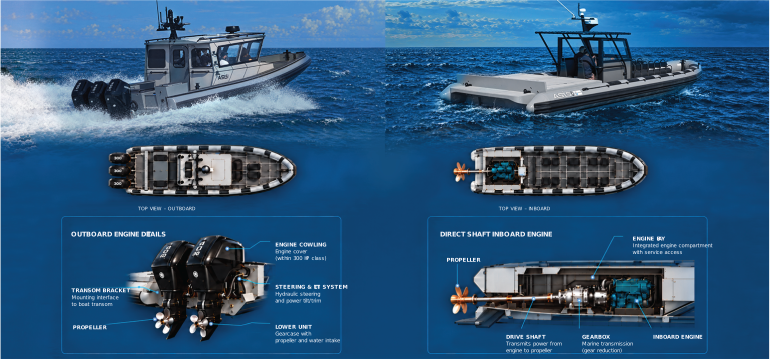
Note: Images are for illustrative purposes only.
| Factor | Inboard | Outboard |
| Best suited for | Open water, longer days out, work off the back of the boat | Shallow water, close-to-shore work, frequent short trips |
| Water conditions | Stable in deep, open, or rough water | Excels in shallow or close-to-shore water |
| Maintenance access | More involved, often needs a service bay or lift | Straightforward, dockside friendly |
| Deck layout | Engine takes up deck or underfloor space | Transom-mounted, frees up deck space |
| Saltwater durability | Higher corrosion exposure over time | Lower risk, motor tilts clear of the water |
| Hours before major overhaul | Diesel: 5,000+ | Gasoline: similar to outboard | Gasoline: 1,500 to 2,000 |
So, Which One Should You Actually Buy?
Go inboard if you spend most of your time in open or choppy water, you need the boat to handle predictably at low speed alongside other vessels, or open, unobstructed access over the back is non-negotiable for how you’ll use it.
Go outboard if deck space matters more to you than what’s happening under the floor, you regularly run shallow or unfamiliar water, you’d rather do your own routine maintenance than book it into a service bay, or you want the lowest corrosion upkeep when the boat sits afloat between uses.
Here’s the thing I tell every customer, regardless of which way they’re leaning going in: a spec sheet will get you 80% of the way to a decision, but the last 20% only comes from a sea trial. Put both configurations under your own hands, in your own conditions, with your own crew aboard. The “feel” difference between a centered, torquey inboard and a light, responsive outboard is real, and it’s the kind of thing you notice in your gut before you can put it into words. That’s usually the moment the decision makes itself.

Frequently Asked Questions
1. Is an inboard or outboard engine better for saltwater use?
Outboards generally hold up better in saltwater because the motor can be tilted clear of the water when not in use, reducing corrosion exposure to the lower unit. Inboard running gear stays submerged full-time, so it needs closer attention to anodes and through-hull fittings over the years.
2. Which is faster, an inboard or an outboard?
Outboards typically win on acceleration and hole shot (how hard the boat pulls away from a standstill) because of their power-to-weight advantage. Depending on hull design and rigging, a modern 200 HP outboard can deliver similar or even quicker acceleration than a heavier 250 HP inboard installation, though top-end speed depends heavily on the hull and total rigged weight.
3. Why do some boats still use inboard engines?
Because propulsion is delivered from a fixed shaft beneath the hull and steering is controlled by a rudder, inboards often provide predictable low-speed handling and strong directional stability. That matters for coming alongside, holding position, and towing.
4. Do outboard motors require less maintenance than inboards?
Routine maintenance is easier on an outboard since the motor is external and accessible dockside. Inboard service usually means access panels or an engine bay, and sometimes a lift, which makes basic jobs more involved even if the engine itself isn’t inherently less reliable.
5. How long do inboard engines last compared to outboards?
Well-maintained inboard diesels commonly reach 5,000 hours before a major overhaul, and 8,000 or more with disciplined servicing. Gasoline four-stroke outboards commonly reach 1,500 to 2,000 hours before major rebuilds become likely, with commercial operators often exceeding that through disciplined maintenance. Most of that difference comes down to diesel versus gasoline rather than the mounting position itself.
 Customizable seating and storage arrangements
 Available as an upgrade option for all ASIS boats ranging from 5.1 meter to 12 meter
 4 WD
4 WD FBW- Fly-by-wire
 G2 Design
 SAFETY
 QUALITY
 PERFORMANCE