

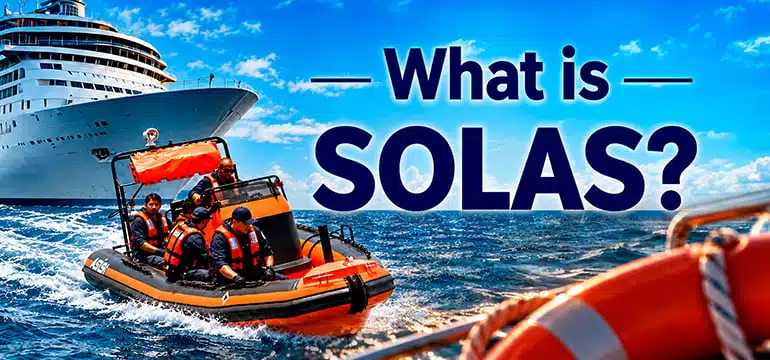
What Is SOLAS ?
What Is SOLAS? Safety of Life at Sea Explained
SOLAS stands for Safety Of Life At Sea. It is the international convention that sets minimum standards for how vessels are built, equipped, and operated.
For professionals working with commercial boats, RHIBs, rescue boats and other specialized marine vessels, understanding SOLAS is important. It provides an international framework designed to improve safety and protect lives at sea.
RIB (rigid inflatable boat) and RHIB (rigid hull inflatable boat) refer to the same type of boat. RHIB is the term more commonly used in defense, coast guard and professional rescue operations, and the one we use in this article.
Both describe a solid hull with inflatable tubes around the outside, a combination that makes the boat fast and seaworthy, yet buoyant and forgiving alongside another vessel. That is why it became the standard for rescue and patrol work.
So what exactly is SOLAS, what does it cover, and how does it relate to rescue and patrol boats?
What Is the Meaning of SOLAS?
SOLAS is the International Convention for the Safety of Life at Sea. It exists because of a disaster.
When the Titanic sank in 1912, she carried lifeboats for barely half the people aboard, and she was within the rules of the day. The first SOLAS convention followed in 1914. It set out how many lifeboats a ship must carry, what radio watch it must keep, and how ice in the North Atlantic would be patrolled.
That first convention never entered into force, overtaken by the First World War. The principle held, though: safety at sea would be agreed internationally rather than left to each owner to decide. The convention has been rewritten several times since. The current version, SOLAS 1974, was adopted on November 1, 1974 and entered into force in 1980.
What Is the Purpose of SOLAS?

SOLAS establishes minimum safety standards for vessels and their crews.
The convention addresses maritime safety across several areas:
- Vessel construction and structural safety
- Fire protection and firefighting
- Life-saving appliances
- Emergency procedures
- Radiocommunications
- Safety of navigation
- Cargo safety
- Dangerous goods
- Safety management (the ISM Code, Chapter IX)
- Requirements for specific ship types and operations (Chapters X to XV)
Safety is not treated as equipment bolted on at the end. It has to be built into the design, the equipment, and the way the vessel is operated.
What Does SOLAS Cover?
SOLAS is divided into chapters, with each chapter addressing a specific area of maritime safety.
Some of the most relevant include:
Chapter II-1, Construction: Covers structural safety, subdivision, stability, machinery and electrical installations. Subdivision means how the hull is divided into watertight compartments, so that flooding in one does not sink the ship.
Chapter II-2, Fire Protection: Covers fire prevention, detection, containment and fire-fighting systems.
Chapter III, Life-Saving Appliances: Covers life-saving equipment and arrangements, including rescue boats, survival craft, life jackets, launching arrangements, training and maintenance.
Chapter IV, Radiocommunications: Covers maritime distress and safety communications.
Chapter V, Safety of Navigation: Covers a range of navigation safety requirements.
For manufacturers and operators of rescue and safety boats, Chapter III is particularly important.
Does SOLAS Apply to RHIBs?

Not every RHIB must comply with SOLAS. Applicability depends on the vessel’s type, size, operation, voyage, and relevant regulations.
SOLAS generally covers passenger ships on international voyages and cargo ships of 500 gross tonnage or more, measured by enclosed volume, not weight. A rescue RHIB is not a SOLAS vessel in its own right. It is regulated under Chapter III and the LSA Code because it is carried aboard one, as that ship’s required rescue boat.
For example, a 7-meter RHIB serving as a cargo ship’s required rescue boat must be approved under Chapter III. Operated independently by harbor police, it would generally follow different regulations. The hull is unchanged; its role determines the applicable requirements.
“SOLAS compliant” alone can be misleading. Required life-saving appliances must be approved by the ship’s flag-state Administration, not the IMO or builder. Administrations often delegate testing and certification to Recognized Organizations (ROs), such as DNV, Lloyd’s Register, ABS, and Bureau Veritas.
Ask suppliers which Administration approved the boat and against which requirements. ASIS certifications outline what our boats are built and approved to.
The correct approach is to identify the boat’s intended purpose, then determine which requirements apply.
Which Ships Must Carry SOLAS Rescue Boats?

SOLAS rescue boats are generally required on passenger ships and on cargo ships of 500 gross tonnage and above engaged on international voyages. The number and type depend on the ship. Ro-ro passenger ships, for example, must also carry a fast rescue boat.
The final requirements for any ship are set by its flag-state Administration.
SOLAS Chapter III and Rescue Boats

SOLAS Chapter III focuses on life-saving appliances and arrangements.
The chapter includes requirements covering areas such as rescue boat stowage, embarkation, launching and recovery, recovery of people from the water, emergency training, operational readiness, maintenance and inspections.
These requirements are supported by the International Life-Saving Appliance (LSA) Code, covered in more detail below.
For a rescue boat, these requirements are particularly significant.
A rescue boat may be required to launch quickly, operate in difficult sea conditions, approach a person in the water and safely recover survivors. Its reliability and readiness can therefore become critical during an emergency.
What Is the Difference Between a Rescue Boat and a Lifeboat?

These terms, used in SOLAS Chapter III, are not interchangeable.
A lifeboat evacuates people from a ship being abandoned, while survival craft includes lifeboats and liferafts designed to sustain people after evacuation. A rescue boat recovers people in distress, retrieves survivors, and gathers or tows liferafts clear.
This distinction shapes their design: lifeboats prioritize capacity and endurance, while rescue boats focus on rapid launching, maneuverability, and recovery.
Under LSA Code Chapter V, Section 5.1, a rescue boat must be 3.8–8.5 meters long, carry five seated people plus one on a stretcher, maintain 6 knots for four hours, and tow the ship’s largest liferaft at 2 knots.
A fast rescue boat must be 6.0–8.5 meters long, achieve 20 knots with three crew members, and maintain 8 knots fully loaded, both for four hours.
The Code permits rigid, inflatable, or combined construction, including RHIBs.
SOLAS and the International LSA Code
The International Life-Saving Appliance (LSA) Code is closely connected to SOLAS Chapter III.
The Code provides specific technical requirements for life-saving appliances, including rescue boats. It also addresses requirements related to manufacturing, testing and the equipment used with life-saving appliances. It covers a wide range of equipment, including life jackets, lifebuoys, survival craft, rescue boats and launching appliances.
The distinction is simple:
SOLAS provides the international regulatory framework, while the LSA Code provides detailed technical requirements for applicable life-saving appliances.
Together, they create a structured approach to life-saving equipment and arrangements.
SOLAS Requirements and RHIB Design

RHIBs offer several characteristics that make them useful in operational roles, including rescue, patrol, security, transportation and offshore support.
However, professional use demands more than speed or maneuverability.
Boats operate in demanding environments. A rescue RHIB may be called on in an emergency. A patrol boat may stay offshore for extended periods. A personnel transport boat may need to work in heavy sea conditions.
Boats must perform in the conditions their mission puts them in. Safety therefore has to be considered throughout the design and construction process.
Hull design, stability, buoyancy, propulsion, steering, deck layout, seating, equipment placement and access can all influence how effectively a boat performs its mission.
Manufacturers are responsible for more than meeting requirements. The boat has to be practical, reliable, and suited to the conditions it will work in.
A RHIB designed for a demanding mission needs to consider factors such as:
- Stability
- Buoyancy
- Passenger and crew capacity
- Equipment integration
- Deck accessibility
- Visibility
- Protection of occupants
- Propulsion performance
- Recovery of personnel from the water
- Operational endurance
The exact requirements depend on the boat’s mission and the applicable regulations.
Those trade-offs are where experience shows. Twenty years of building rescue and patrol boats for operators in more than 80 countries has taught us where they sit. We build them in fiberglass and aluminum.
Is SOLAS Just a Certification?
Not at all.
Several factors contribute to safety, including design, construction, equipment, inspection, maintenance, training, and operation.
SOLAS Chapter III, for example, includes requirements for life-saving appliances’ operational readiness, maintenance, and inspection.
In other words, safety does not end when a boat leaves the factory.
Throughout its service life, an operational vessel must be properly maintained and operated.
Why SOLAS Matters to Boat Operators
SOLAS helps boat operators establish internationally recognized safety expectations.
It gives manufacturers requirements that shape vessel design and equipment. It gives crews the assurance that emergency equipment is aboard and ready.
And ultimately, the purpose is simple:
To improve the chances of protecting human life at sea.
If you are specifying a rescue boat and need to establish which requirements apply to your operation, our engineering team can work through it with you. Talk to our engineers.

 Customizable seating and storage arrangements
 Available as an upgrade option for all ASIS boats ranging from 5.1 meter to 12 meter
 4 WD
4 WD FBW- Fly-by-wire
 G2 Design
 SAFETY
 QUALITY
 PERFORMANCE